


South African Vocal Group Returns to Anthology
Wednesday, February 22, 2012 15:17An Interview with Albert Mazibuko of Ladysmith Black Mambazo
by: Casey Pukl
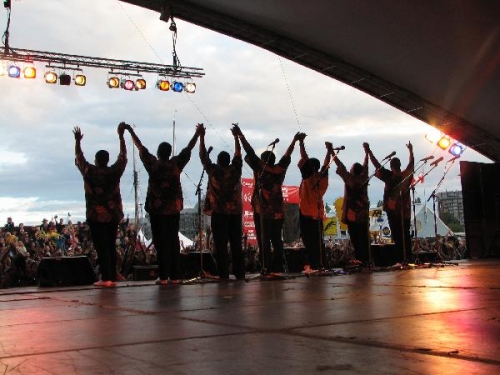 It’s pretty incredible to think about the history of Ladysmith Black Mambazo. Not only do they have stunning musical accomplishments (16 Grammy nominations!) and a flawless catalog, but they also were the first group in South Africa to have permission to travel freely throughout the country.
This multi-generational vocal group is returning to Anthology after a year that included two new albums, endless collaborations, and another Grammy Award nomination. Read on to find out what’s on deck for 2012 and more!
CP: Congratulations on the Grammy nomination for “Songs From A Zulu Farm”!
AM: Thank you! We are just so happy about that. In December when I was home, I heard the news, and we were just over the moon. It’s so wonderful.
CP: That was what, your 16th nomination?
AM: Yes, and they’re all still so exciting!
CP: Tell me a little bit about that record. I know it’s a more traditional record with several songs being sung in Zulu.
AM: The songs on the album are songs that we used to sing as children growing up on the farm. The music is from the start of our lives. Our friends from the USA asked us about home and where we were introduced to the music, so we told them the story about how we learned this music when we were very young. They said, ‘Wow! Why don’t you put those together and we can make an album!’ So we started to remember the music and put it all together. We had to expand the music because it was all chanting. So that’s how the whole project came about.
Also, when we were in the studio, we finished recording all the songs, and we asked them if there were any American farm songs. One of the guys said, ‘Yes! Yes!’ He said it was called ‘Mr. MacDonald Had A Farm’. Luckily some of our grandsons that were there in the studio knew the song and used to sing it in school. So we sang the song and put some new lyrics in it. It worked so well, and we were so happy. This was the happiest album making in the studio. There was so much laughing and joking. It was a happy moment!
CP: How the idea for your latest album, “Ladysmith Black Mambazo and Friends” come about?
AM: This album is a compilation of all those songs we have done with other people. Our fans always ask where they can get the song we did with so and so, and this other song with so and so. So we thought it would be good to put them all in one place on an album. So we’re making it easier for people to get all of the music they’re looking for on one CD.
CP: Who does most of the arranging?
AM: Joseph Shabalala, the founder and leader of the group, he does most of the composing and arranging. In this album, he worked together with one of the senior members of the group who joined in 1974, so they worked together.
CP: Going back a bit, you’ve toured the world over such a long period of time and through some incredibly challenging political situations and conflicts. Was it difficult to set up your tours throughout the years?
AM: It was. It was really challenging back in the days. Ladysmith Black Mambazo was really known all over South Africa, and we got invitations to sing all over. I remember we used to drive in the night because we were working full time then and doing music part time after work. Every Friday in the evening after work, we’d get in the car and start driving to all these different places with checks and all that. So when the police would stop us, they’d ask where we were going, if we had permission to be there, that kind of stuff. So when they’d ask us, we told them we sing. They’d ask us what kind of music, and we’d try to explain, but people didn’t understand it. The media was divided in South Africa, so other people didn’t know about us, so we had to sing for them just to show them what kind of music we were talking about.
CP: Wow!
AM: Yes, we used to sing for them, and they’d call to each other and say, ‘Come listen to this; it’s so beautiful!’ They let us go all the time (laughs). There was one time that there was a big roadblock, and the commissioner of the area was there. We did our singing there also, and so they called him to come and listen. He said, ‘This is beautiful. You shouldn’t be stopped.’ And then he made a note and told us to go to our magistrate in our area to request a permission to travel.
So we did that! All of us went there in full uniform, and we sat down in the chairs in the courtroom, and one of our cousins represented us. The magistrate had never heard of us, but then said, ‘Let me ask, what kind of music are we talking about?’ No one had ever asked for this permission. We stood up, started the song, and we sang for them. He took off his glasses, and said, ‘This is beautiful.’ And then he granted us permission, and told us we had to renew it every two years. We were the first group in South Africa to have permission to travel.
Every time we got to a checkpoint, we’d just show them our paper, and everyone was always surprised we had permission to travel. It was wonderful.
CP: That’s incredible. What do you guys have on deck for 2012?
AM: This is the year that we said we want to accomplish a number of things. We are now working on a gospel album. We recorded some demos, so now we’re experimenting. We want to use music that is almost forgotten, because our aim in our music is to keep the history and culture alive. We are still collecting all of the gospel music from everywhere— America, South Africa, all over.
Also, we’re working on music that has been sung by Joseph Shabalala’s late wife, Nellie, and her group Women of Mambazo. That one is recorded, so we’ll see which one we release first.
CP: Excellent. What are you most looking forward to about returning to Anthology?
AM: We are looking forward to it! Every time we do something, we expect a good outcome and want to make people happy. We want to keep the tradition alive. We are so looking forward to being there. I can’t wait!
Special thanks to Albert for taking some time out for our blog!
Ladysmith Black Mambazo on Spotify
WHAT: Ladysmith Black Mambazo
WHEN: Saturday, February 25, 2012, 7:30pm
TICKETS: $18-$77 Buy Tickets
MORE INFO: Artis